Showing posts with label Behavior. Show all posts
Showing posts with label Behavior. Show all posts
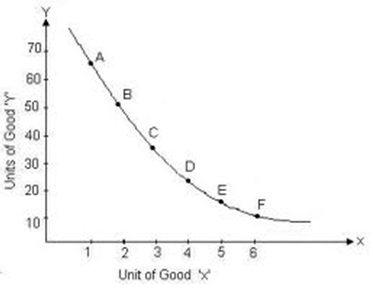
Indifference curve
A graph used to illustrate the effect of different quantitative combinations of goods on consumer satisfaction and behavior. A quantity of one good is shown on axis x and a quantity of another one – on axis y. The curve that is formed illustrates that certain consumers are equally satisfied at each curve’s point.


Behavioral self-management
Applying specific procedures by a sales person that are conducted to improve performance and to achieve better sales results, for example tracking time per call in telemarketing, setting certain norms at new account opening, exploring certain sales techniques on regular basis, etc. Behavioral self-management enhances sales skills and capabilities by monitoring and adjusting one’s own practice.
Cognitive age
The perceived age of an individual which is usually 10-15 years younger than his or her biological age. Cognitive age varies widely with individual years of age and it is also influenced by factors as his or her health condition, education level, social status - the more of each of these three, the lower is Cognitive age. In the context of Consumer behavior, it could be stated that a wide range of attitudes and consumption behaviors are associated with Cognitive age rather than the actual chronology of the biological age.
Meme theory

The word “meme” is borrowed from genetics and was introduced by the biologist Clinton Richard Dawkins in his book “The Selfish Gene” (1976) that presented a concept on how the dissemination of cultural phenomena evolve. Views, perceptions, ideas, fashion, music, catchy phrases, products and technologies are all examples of meme that spread into popular culture and human behavior analogously to genes.
Social Cost Benefit Analysis (SCBA)
Measuring the social impact of a private project or a state policy, i.e. how these would affect people’s lives is analyzed. Social Costs measure negative impact, while Social Benefits stand for the positive impact. SCBA focuses on factors like environmental effects, traffic, demography, i.e. aspects of no market pricing. It is typically used before launching larger project in building and construction. Sometimes SCBA may also affect projects pricing.
Discretionary buying power
The cash abilities that consumers have after they have paid taxes, mortgages nad other obligations that they may have. Also referred to as “loose money”. Stable overall levels of consumers discretionary buying power are crucial for economic health within a country.
Acculturation
The process of adapting to cultural environments that are new to an individual, i.e. a recent immigrant to the US who is getting used to the American customs, language, traditions, etc.

Concomitant variation
Relationship between two or more variables where their values are dependent of one another. Cause-and-effect is one example of such variation.
Conformance quality
Conformance quality could range from low to high. When a product doesn’t meet consumers’ expectations and disappoints them after purchase, there is a low conformance quality. The better satisfaction of a product is, the higher quality of conformance.
KISS principle
KISS is an acronym for “Keep it simple stupid” in the context of design and “Keep it simple straightforward” as a phrase related to the field of marketing analysis, presentation of research data, etc.
Inherent bias
In marketing research, statistics and interrogation, it’s the effect from various factors, such as human sympathy, prejudice and/ or assumptions that lead to distortion of accurate inferences and conclusions.
see also: Cognitive bias, Systematic bias
see also: Cognitive bias, Systematic bias
Systematic bias (Systematic error)
Fluctuations in measurements that shift aside from actual values needed to be taken. These errors occur due to imperfections of the measuring instruments, as well as changes of environment during the process of measuring.
see also: Cognitive bias, Inherent bias
see also: Cognitive bias, Inherent bias
Cognitive bias
Fallacy in judgments due to limitation of perceptions, memory flaws, wrong attribution and/ or other weaknesses of human thinking. Different kinds of cognitive biases affect formation of believes, decision-making and behavior.
see also: Inherent bias, Systematic bias
see also: Inherent bias, Systematic bias
Mission statement
Company's formulation of its purpose to exist - core organization's target and distinction.
Accrual
Adding together and/or taking out expenses or revenues on balance sheet over certain accounting periods. For example, a company delivers a service to another company which will pay for it in 30 days, in the next fiscal year and the new fiscal year for the providing company is to begin in a week after delivery of service. In this case the company will record the future income as a revenue in the current income statement which is part the nearly ending fiscal year, despite the fact that it will be actually paid during the new accounting period.
Multiple-choice question
A question that requires an answer among possible options. Questionnaires of that kind may be utilized for various purposes as to test level of knowledge, as well as to conduct research and surveys.

Defense mechanism
Psychic act due to unconcious tension pursuing to relieve the pressure caused by the id and superego. According to Freud's theory, defense mechanisms exists as ways of solving inner conflicts and keeping personal integrity.
Mood/affect
An individual’s subjectively perceived “feeling state”. Affect is change of mood while expressing emotions. At work, colors and spacing affect our moods, emotions and behaviors, in a different way on different people, though. Studies, reseasrch and practicing on color effects in order to induce certain affects in people is termed color psychology. Doubted by some critics, this field is called pseudoscience.
Overshadowing effect
This term is used in the context of classical conditioning learning theory, which refers to a stimulus that becomes as important as or more important than the unconditioned stimulus.
Punishment
The learning that occurs when a response is followed by unpleasant events (such as being ridiculed by friends for wearing an offensive smelling perfume). In the context of consumer behaviour, punishment leads to non-repeat behaviour for a particular product/brand/service.